If feeding is going well, you may not need one
Picture the ideal: breastfeeding works, or the bottles go smoothly, your baby is growing well at check-ups, and you feel sure your baby is eating and thriving. In that world, a feeding tracker adds little. Your baby's cues already tell you what you need to know.
Official guidance points the same way. The World Health Organization asks parents to practise responsive feeding, recognising and responding to signs of hunger and fullness, and the American Academy of Pediatrics encourages parents to look to their baby rather than the clock.
Some feeding specialists go further, and they have a point. Therapists who help babies with bottle refusal often work on helping parents step back from the numbers, because measuring every feed can raise anxiety, create expectations about volumes and timings, and babies notice that tension. If tracking makes feeds feel more stressful in your home, stopping is a perfectly good choice.
Research on feeding apps is still small and mixed. In one interview study, breastfeeding mothers said tracker apps gave them a feeling of control and confidence, but also worried about relying on them and being overwhelmed by data. Another survey linked lighter app use with better feeding interactions than heavy use.
But that is not how it looks for many families
Real feeding is often messier. Newborns feed about 8 to 12 times in 24 hours, and during cluster feeding the CDC notes it can be as often as every hour. Add sleep deprivation and the days and nights blur together quickly.
- Mixed feeding is common. In CDC data for babies born in 2023, 22.6% of breastfed infants received formula within their first two days, and fewer than a third were exclusively breastfed through six months. Nursing, pumping and formula in the same day is normal, and hard to keep in your head.
- Bottles run on a clock. The CDC says prepared formula should be used within 2 hours of preparation and within one hour from when feeding begins. Freshly expressed breast milk can stay at room temperature for up to 4 hours, and leftovers should be used within 2 hours. At 3am, “when did I make this?” is a real question.
- More than one person feeds. When a partner, grandparent or sitter takes a turn, “when did she last eat?” needs an answer nobody has to remember.
- Sometimes someone asks for a record. A pediatrician, health nurse or lactation consultant may want to know what a normal day looks like.
This is where a feeding tracker can earn its place: not as a judge of how feeding should look, but as a memory for tired parents.
Where I come from
I am Robin, a dad of two in Norway, and I built Feed Flow. When our first daughter arrived we had trouble with breastfeeding, and everything turned into a confusing mix of nursing, pumping and formula. Some days we made 14 bottles, some barely touched, some half drunk, and we poured a lot of formula down the drain because we could not see the pattern. We wrote feeds on paper and in our phones because, as new and insecure parents, we just wanted to know what was normal and whether she was getting enough.
Feed Flow started as a simple way to stop giving a bottle that had been out too long, and to stop throwing away milk that was still fine. It grew into one view of every kind of feed, tested every day on our own children. I will say honestly what I told a feeding specialist who disagreed with tracking: obsessing over numbers is not good for anyone. The goal was never more numbers. It was an app that helps you instead of becoming one more chore: calm, useful and even a little playful. That is still how we build Feed Flow, as parents who struggled with feeding ourselves.
If you do track, track in a way that keeps you calm
- Log less, not more. Record what helps you, skip what does not. A missed entry is not a failure.
- Let the app do the arithmetic. Totals, averages and timings should not be your job at 3am.
- Watch your baby, not the screen. The record is a memory aid. Your baby's hunger and fullness cues come first.
- Use patterns, not single numbers. One small feed means little. A week can show what is normal for your baby.
- Keep what helps, drop what does not. Some parents stop logging bottles once things settle. Others keep going through the move to solid foods, because seeing feeding, growth, development and allergen introductions in one place is genuinely useful. Either is fine; you never owe the app an entry.
How Feed Flow tries to help without adding pressure
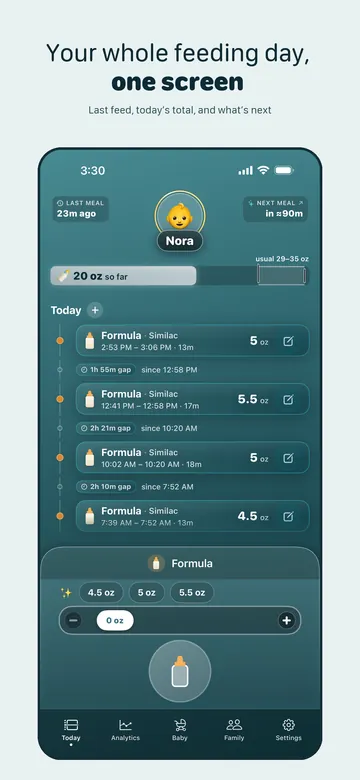
Feed Flow, the formula & feeding tracker for iPhone, was designed by a sleep-deprived parent to take thinking off your plate rather than give you more numbers to analyse.
- One view of every feed. Nursing, pumping, expressed milk, formula, water and solids sit in one timeline with one milk total.
- No mental maths. You slide a picture of the bottle to show what was drunk and read what is left. After a few bottles, the amounts you usually pour become one-tap buttons, so you prepare closer to what your baby takes and waste less.
- A bottle countdown on your Lock Screen. It runs from when you make the bottle, one hour for formula and two hours for pumped milk by default, and you can adjust it to your label and local guidance. It is a reminder, not a safety sensor.
- FlowCast next-feed predictions. After about four days of logged feeds, FlowCast learns your baby's own rhythm and shows a likely window for the next feed and the day ahead. Babies change with growth spurts, illness and development, so it is a guide, never a schedule.
- Vitamin D, added up for you. Feed Flow counts the vitamin D in the formula your baby drank, from the label, plus any drops you log, and shows what remains toward the 10 µg / 400 IU daily reference. Whether and how much to supplement is your and your clinician's decision.
- Growth against WHO references. Weight, height and head circumference are shown against the WHO Child Growth Standards, as context, never as a grade.
- Health in the same story. Log reactions, sick periods, medicines and the nine major allergens as your baby moves to solids, and keep track of which formula you use and how your baby does on it.
- A report when someone asks. Share a clear PDF with your partner, health nurse or pediatrician instead of reconstructing a week from memory.
What Feed Flow does not do
It does not diagnose, set targets, tell you how much your baby should drink or grade a feed. It has no ads and no sponsored or paid formula brands. Formula products appear only so you can record what you use, and the app does not recommend one product over another. Your baby's records live on your phone and in your own iCloud.
If you are worried about feeding, weight, wet diapers, hydration or how your baby seems, contact your pediatrician, health nurse or a lactation consultant. Do not wait for an app to tell you something is wrong.
A quick test: would a tracker help you right now?
- Are you losing track of when your baby last fed, or which side, or which bottle?
- Is more than one person feeding your baby?
- Are bottles going down the drain because you are not sure how long they have been out?
- Has a professional asked you to keep a record?
- Does logging make you calmer, or more anxious?
If you answered yes to the first four, a tracker can take real load off your day. If logging makes you more anxious, that matters more than any feature: put the app away and follow your baby.