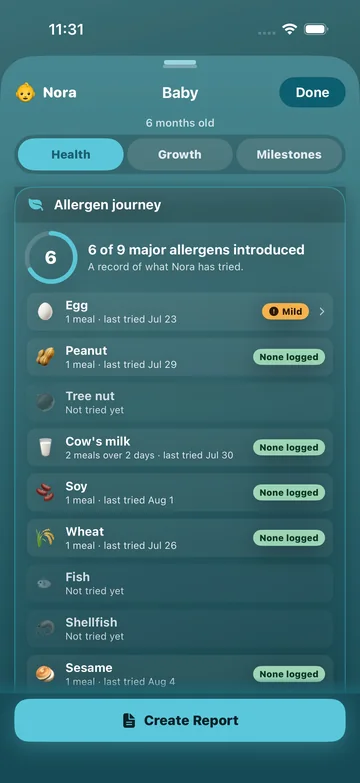
Record the food event before the details fade
- The food or allergen and the meal it appeared in.
- The date and time it was offered.
- Other foods or relevant events around the same meal.
- Any notes you chose to keep about the feeding.
Do not delay urgent care to complete a diary. For severe, rapidly worsening or breathing-related symptoms, seek emergency medical help first.
Add the observation at its actual later time
If you notice something the next morning, record it then rather than placing it at yesterday's meal. Feed Flow lets the original egg entry and today's reaction note remain separate but connected events.
Food event preserved.
Observation preserved at its later time.
Write what you observed rather than assigning a diagnosis. A professional can ask about appearance, duration, other symptoms, illness, medications and the broader context.
Do not let the timeline decide causation
“After egg” is not the same as “because of egg.” Symptoms can coincide with another food, a viral illness, skin irritation or an unrelated event. Likewise, the absence of a logged reaction does not prove future tolerance.
Feed Flow does not diagnose allergies, predict reactions or tell you to reintroduce a food. Those decisions require a qualified health professional who can assess the child and the complete history.
Bring the record, not just the conclusion
A chronological food and health record can help a pediatrician, allergist or dietitian ask better questions. Keep medicine and vaccine records available too when they are relevant.
For clinical background, the US National Institute of Allergy and Infectious Diseases publishes food allergy guidelines for clinicians and patients. Introduction and management advice should be individualized, especially after a previous reaction or when eczema or an existing allergy is present.